
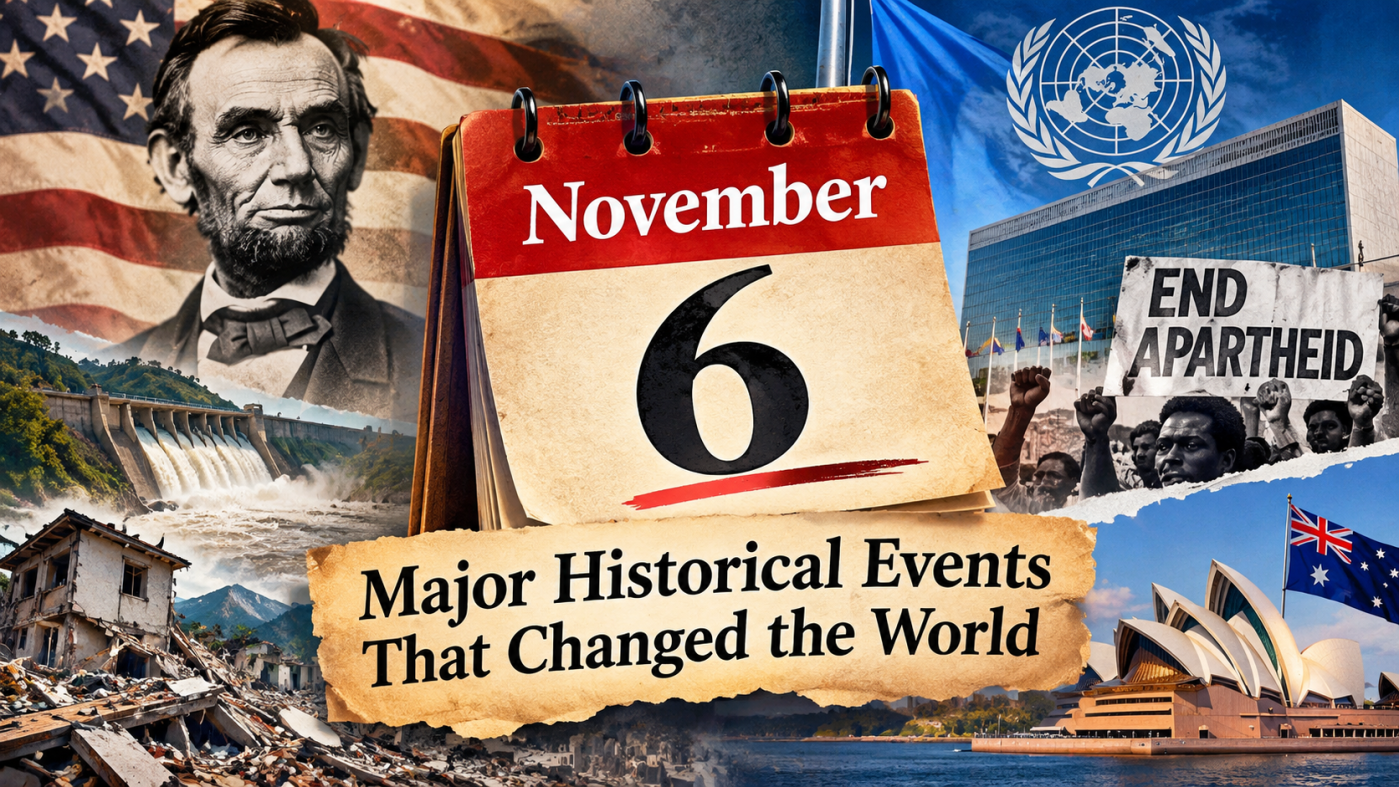
What Happened on November 6? Major Historical Events That Changed the World
November 6 is a date associated with several important events in world history. From presidential elections and political revolutions to devastating natural disasters, this day has witnessed moments that influenced nations and shaped the modern world.
Let’s explore some of the most significant historical events that happened on November 6.
1. Abraham Lincoln Was Elected President (1860)
On November 6, 1860, Abraham Lincoln was elected as the 16th President of the United States.
His victory was a major turning point in American history. His opposition to the expansion of slavery increased political tensions between Northern and Southern states, eventually contributing to the outbreak of the American Civil War in 1861.
Lincoln later became one of the most influential presidents in American history.
2. The United Nations Condemned Apartheid (1962)
On November 6, 1962, the United Nations General Assembly adopted Resolution 1761, condemning South Africa’s apartheid policies.
Apartheid was a system of institutionalized racial segregation and discrimination that denied the majority Black population basic rights.
The resolution called on UN member states to take action against the apartheid regime. It became part of the international effort to end racial discrimination in South Africa.
3. The Kelly Barnes Dam Disaster (1977)
On November 6, 1977, the Kelly Barnes Dam near Toccoa, Georgia, in the United States, collapsed.
The resulting flood devastated nearby areas and caused the deaths of 39 people.
The disaster became an important reminder of the dangers of poorly maintained dams and the importance of infrastructure safety.
4. The Colombian Palace of Justice Siege (1985)
On November 6, 1985, members of the M-19 guerrilla movement stormed the Palace of Justice in Bogotá, Colombia.
The incident triggered a violent military response and a two-day siege that resulted in more than 100 deaths.
It remains one of the most tragic and controversial events in modern Colombian history.
5. Major Earthquakes Struck China (1988)
On November 6, 1988, a series of powerful earthquakes struck the Lancang and Gengma areas of Yunnan Province in southwestern China.
The earthquakes caused widespread destruction, damaged buildings, and resulted in hundreds of deaths.
The disaster highlighted the vulnerability of communities living in earthquake-prone regions.
6. Australia Rejected Becoming a Republic (1999)
On November 6, 1999, Australia held a national referendum on whether to replace its constitutional monarchy with a republic.
Although the proposal attracted considerable public attention, the majority of voters rejected the change.
As a result, Australia remained a constitutional monarchy, with the British monarch continuing as its head of state.
Famous People Born on November 6
November 6 is also the birthday of several well-known personalities:
- John Philip Sousa (1854): American composer and conductor, famous for his military marches.
- Sally Field (1946): Academy Award-winning American actress.
- Emma Stone (1988): Academy Award-winning actress known for films such as La La Land and Poor Things.
Why Is November 6 Historically Important?
November 6 demonstrates how a single calendar date can connect different periods of human history.
From Abraham Lincoln’s election in 1860 to Australia’s constitutional referendum in 1999, the events associated with this day reflect major political, social, and historical changes.
It also reminds us that history is not shaped only by wars and political leaders. Natural disasters, social movements, and decisions made by ordinary voters can also have lasting consequences.
History is made every day, and November 6 is one date worth remembering.
Eksplorasi konten lain dari Goonung
Berlangganan untuk dapatkan pos terbaru lewat email.


Tinggalkan Balasan