
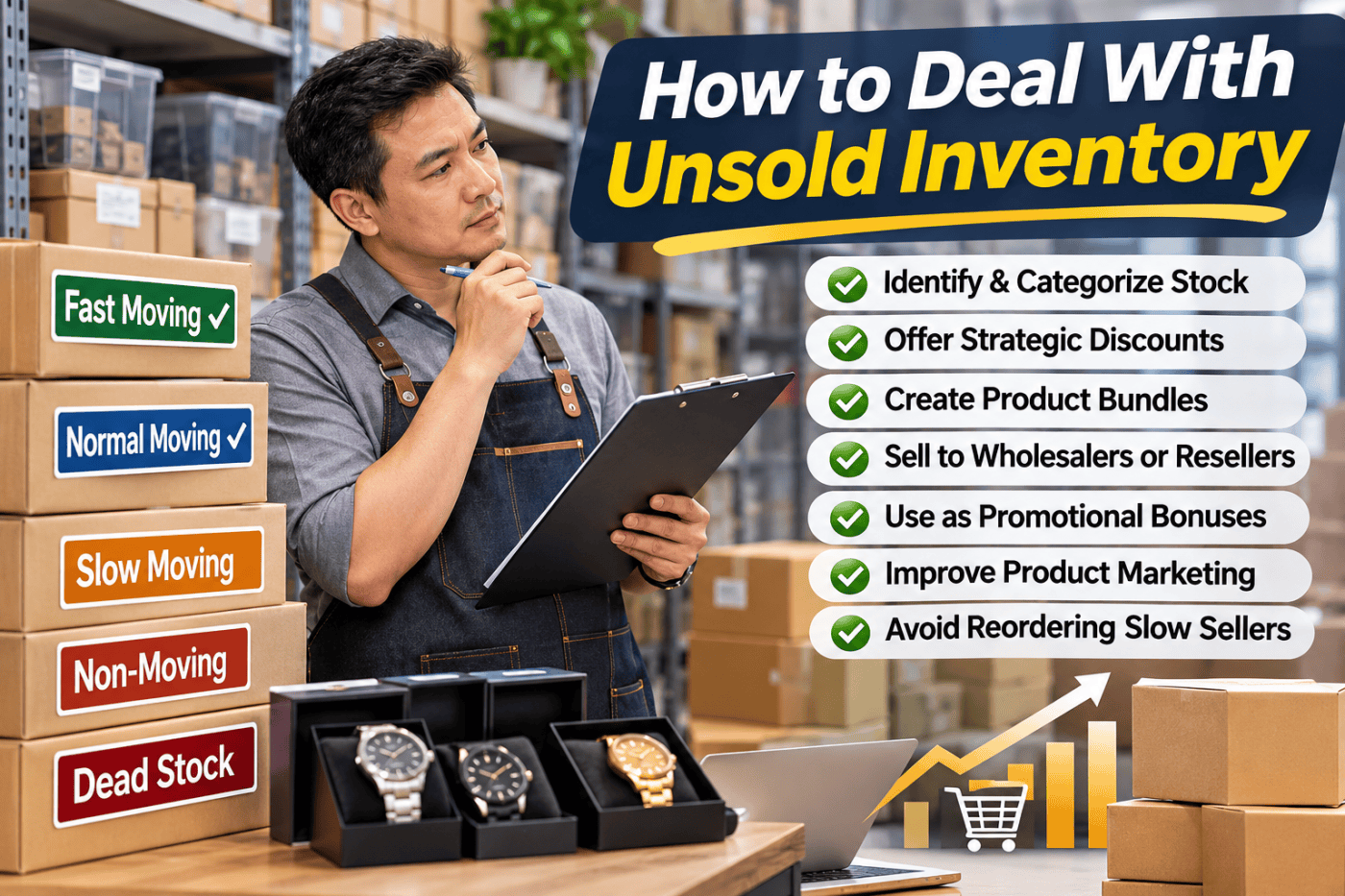
How to Deal With Unsold Inventory: 7 Effective Strategies to Recover Your Capital
Unsold inventory is one of the biggest challenges faced by retailers, wholesalers, and online sellers. Products that remain in storage for months can tie up valuable capital, increase storage costs, and reduce business cash flow.
However, unsold products do not necessarily mean lost money. With the right inventory management strategy, businesses can turn slow-moving products into sales opportunities and recover capital that would otherwise remain unused.
In this guide, we will explore practical ways to identify, manage, and sell unsold inventory.
1. Identify and Categorize Unsold Inventory
Before taking action, businesses need to understand which products are selling well and which are becoming a problem.
A simple inventory classification system can help:
Category| Description
Fast-Moving| Products that sell quickly
Normal-Moving| Products with stable sales
Slow-Moving| Products that sell infrequently
Very Slow-Moving| Products with very limited sales
Non-Moving| Products with no sales for several months
Dead Stock| Products that have remained unsold for a long period
Businesses can also classify inventory based on how long products have remained unsold.
For example:
– 0–30 days: Normal inventory
– 31–60 days: Monitor sales performance
– 61–90 days: Slow-moving inventory
– 91–180 days: Very slow-moving inventory
– 181–365 days: Non-moving inventory
– More than 365 days: Potential dead stock
These timeframes are guidelines and should be adjusted according to the product category and sales cycle.
2. Offer Discounts to Encourage Sales
One of the simplest ways to move unsold inventory is by offering discounts.
Instead of applying the same discount to every product, adjust the discount according to the product’s condition and inventory age.
For example:
– Slow-moving products: 5–10% discount
– Very slow-moving products: 10–20% discount
– Non-moving products: 20–40% discount
– Dead stock: Special clearance pricing
Before offering discounts, calculate the minimum selling price to understand how much capital can be recovered.
A discount should be a strategic decision, not simply an attempt to sell products at any price.
3. Create Product Bundles
Product bundling is an effective strategy for selling items that customers might not purchase individually.
For example, a watch retailer could offer:
– Buy one popular watch and get a discounted second watch.
– Combine two complementary watch models.
– Offer a watch with an additional strap.
– Create special gift packages.
The key is to combine products in a way that customers perceive as valuable.
Bundling can also help increase the average order value while reducing old inventory.
4. Sell Unsold Products to Wholesalers or Resellers
Some products may not attract individual customers but could still be attractive to other sellers.
Consider offering unsold inventory to:
– Wholesale buyers
– Small retailers
– Marketplace resellers
– Discount stores
– Clearance stock buyers
Selling in bulk may require a lower profit margin, but it can help businesses recover capital faster and reduce storage expenses.
5. Use Unsold Products as Promotional Bonuses
Another option is to use selected slow-moving products as promotional gifts.
For example:
– Free gift with a minimum purchase.
– Bonus item for customers buying premium products.
– Special gifts for repeat customers.
– Promotional packages during seasonal campaigns.
This strategy works best when the perceived value of the bonus is attractive and the cost does not significantly reduce the profit from the main product.
6. Improve Product Marketing and Presentation
Sometimes products remain unsold not because they are undesirable, but because customers have not been presented with enough information or attractive product images.
Consider improving:
– Product photography.
– Product titles and descriptions.
– Marketplace keywords.
– Social media promotion.
– Product demonstrations.
– Customer reviews and testimonials.
For example, an older watch model may attract attention when presented with professional photography, clear specifications, and an appealing lifestyle concept.
Before lowering prices significantly, test whether better marketing can improve demand.
7. Stop Reordering Products That Do Not Sell
Selling existing inventory is only part of the solution.
Businesses must also prevent the same problem from happening again.
Review historical sales data before placing new orders.
Pay attention to:
– Products with consistently low sales.
– Models that customers rarely search for.
– Products with high inventory levels.
– Seasonal demand changes.
– Customer preferences and feedback.
Avoid purchasing large quantities of unfamiliar products without testing market demand first.
A small initial order can help determine whether a product deserves a larger investment.
Build an Inventory Recovery System
For better results, businesses should establish a regular inventory review process.
A simple 30-day review cycle can help:
Period| Recommended Action
First 30 days| Monitor sales performance
31–60 days| Improve product marketing
61–90 days| Introduce promotional discounts
91–180 days| Apply clearance strategies
More than 180 days| Consider bulk sales or liquidation
This system helps business owners make decisions based on inventory performance rather than guesswork.
Conclusion
Unsold inventory does not always represent a permanent financial loss. With proper planning, businesses can recover capital, reduce storage costs, and improve cash flow.
The most important steps are to identify slow-moving products, choose the right sales strategy, improve marketing, and avoid repeating purchasing mistakes.
Remember: The goal is not simply to sell every product at any price. The goal is to manage inventory efficiently, recover capital, and invest in products that customers actually want.
Eksplorasi konten lain dari Goonung
Berlangganan untuk dapatkan pos terbaru lewat email.


Tinggalkan Balasan