
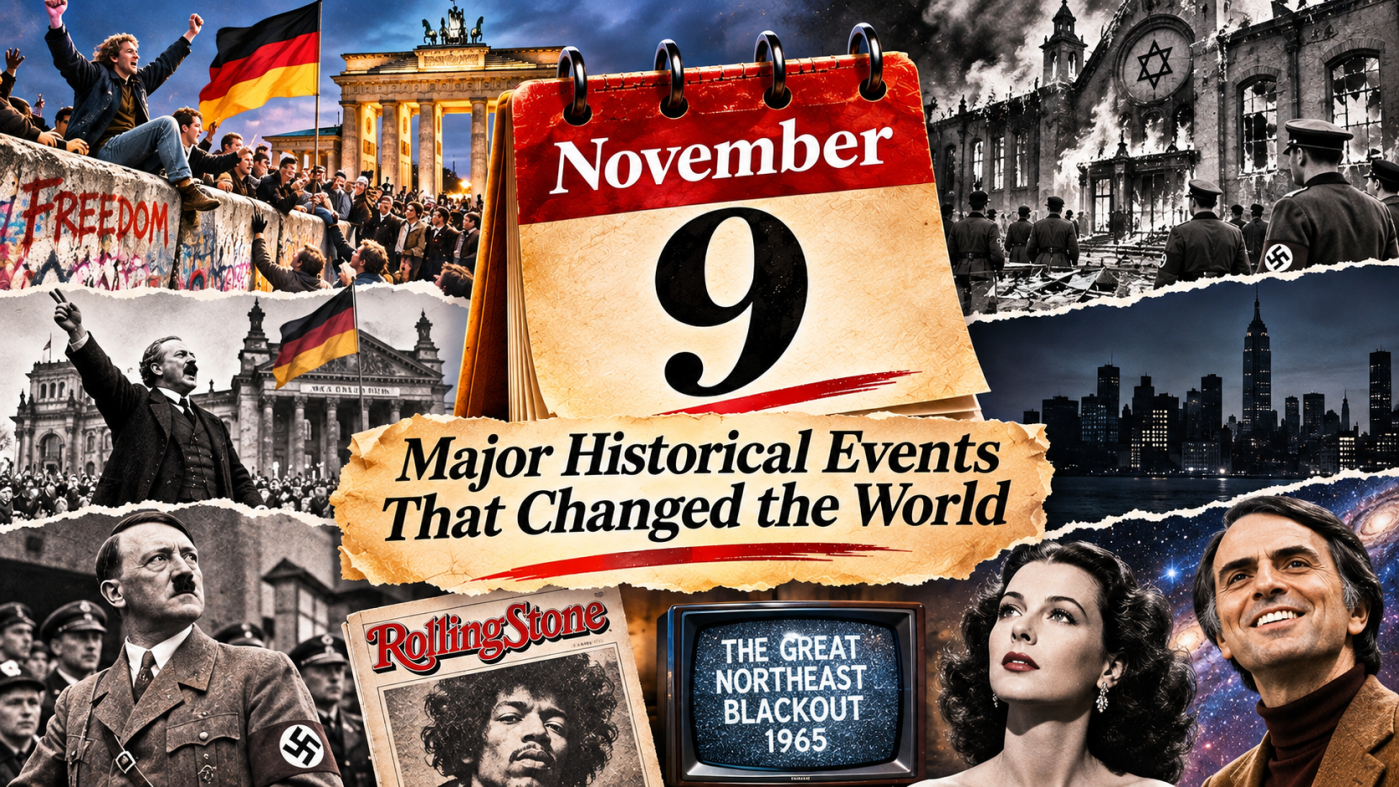
What Happened on November 9? Major Historical Events That Changed the World
November 9 is one of the most historically significant dates in modern European history. It is associated with major political changes, tragic events, and moments that shaped the future of nations.
From the fall of the Berlin Wall to the devastating violence of Kristallnacht, November 9 represents both the darkest and most hopeful chapters of human history.
This date has also witnessed major developments in science, entertainment, and technology.
Let’s explore some of the most significant historical events that happened on November 9.
1. The Fall of the Berlin Wall (1989)
On November 9, 1989, the Berlin Wall, which had divided East and West Berlin for nearly three decades, was effectively opened.
The announcement of new travel regulations by East German authorities caused thousands of people to gather at border crossings.
As border guards eventually allowed people to pass, crowds celebrated by crossing between East and West Berlin. Many people also began breaking sections of the wall.
The Berlin Wall had become one of the most powerful symbols of the Cold War and the division between communist Eastern Europe and the democratic West.
Its opening paved the way for German reunification on October 3, 1990.
2. Kristallnacht: The Night of Broken Glass (1938)
On the night of November 9–10, 1938, Nazi Germany launched a violent campaign against Jewish communities across Germany and Austria.
The event became known as Kristallnacht, or the Night of Broken Glass, because countless windows of Jewish-owned shops were smashed during the attacks.
Synagogues were burned, Jewish businesses were destroyed, homes were attacked, and thousands of Jewish men were arrested.
More than 30,000 Jewish men were sent to concentration camps during the wave of violence.
Kristallnacht marked a major escalation in the persecution of Jewish people under Nazi rule and became an important turning point on the road to the Holocaust.
3. Germany Became a Republic (1918)
On November 9, 1918, German politician Philipp Scheidemann proclaimed the German Republic from a balcony of the Reichstag building in Berlin.
The announcement came during a period of political unrest following Germany’s defeat in World War I.
On the same day, Kaiser Wilhelm II’s abdication was announced, bringing an end to the German monarchy.
The collapse of the empire led to the establishment of the Weimar Republic, Germany’s first parliamentary democracy.
This political transformation marked the beginning of a new and challenging chapter in German history.
4. The Beer Hall Putsch Ended in Failure (1923)
On November 9, 1923, Adolf Hitler and his supporters attempted to seize power in Munich, Germany.
The uprising, known as the Beer Hall Putsch, had begun the previous evening when Nazi supporters attempted to overthrow the Bavarian government.
However, the coup failed after clashes with police forces. Hitler was arrested and later sentenced to prison.
Although unsuccessful, the event became an important chapter in the history of the Nazi movement and Hitler’s rise to political power.
5. The Great Northeast Blackout (1965)
On November 9, 1965, a massive power outage struck northeastern parts of the United States and southeastern Canada.
The blackout affected major cities, including New York, leaving approximately 30 million people without electricity.
Public transportation systems stopped operating, elevators became trapped between floors, and millions of residents suddenly found themselves in darkness.
The incident became known as the Great Northeast Blackout of 1965.
It highlighted the vulnerability of interconnected electrical networks and encouraged improvements in power-grid reliability and emergency planning.
6. Rolling Stone Magazine Published Its First Issue (1967)
On November 9, 1967, the first issue of Rolling Stone magazine was published in San Francisco, California.
Founded by Jann Wenner and music critic Ralph J. Gleason, the magazine initially focused on music, popular culture, and the emerging counterculture movement.
Over the following decades, Rolling Stone became one of the most influential publications in the entertainment industry.
Its coverage expanded to include music, politics, film, interviews, and cultural commentary.
The magazine helped shape how generations of readers understood popular music and modern culture.
Famous People Born on November 9
November 9 is also the birthday of several influential personalities in science, entertainment, literature, and sports.
Hedy Lamarr (1914)
Hedy Lamarr was an Austrian-American actress and inventor.
Although she became famous as a Hollywood film star, she also contributed to the development of frequency-hopping technology with composer George Antheil during World War II.
Their invention helped establish concepts that later influenced modern wireless communication technologies.
Muhammad Iqbal (1877)
Muhammad Iqbal was a philosopher, poet, and political thinker from British India.
He became one of the most influential intellectual figures in South Asian history.
His writings explored philosophy, spirituality, identity, and the future of Muslim communities in the region.
Carl Sagan (1934)
Carl Sagan was an American astronomer, astrophysicist, and science communicator.
He became internationally famous for making complex scientific ideas accessible to ordinary audiences.
His television series Cosmos: A Personal Voyage inspired millions of people to explore astronomy and the mysteries of the universe.
Alessandro Del Piero (1974)
Alessandro Del Piero is a former Italian professional footballer best known for his legendary career with Juventus.
He became one of the most recognizable players in Italian football and helped Italy win the 2006 FIFA World Cup.
His technical ability, creativity, and leadership made him one of the most respected footballers of his generation.
Why Is November 9 Important in World History?
November 9 represents a remarkable contrast between tragedy and hope.
In 1918, Germany experienced the end of its monarchy and the beginning of a republic. In 1938, Jewish communities suffered horrific violence under Nazi rule. In 1989, the opening of the Berlin Wall became a powerful symbol of freedom and the end of a divided Europe.
These events demonstrate how political decisions, social movements, and historical circumstances can change the lives of millions of people.
November 9 reminds us that history is shaped by both the darkest moments of humanity and the courage to build a better future.
Discover more from Goonung
Subscribe to get the latest posts sent to your email.


Leave a Reply